
For over 60 years, Livengrin Foundation has provided compassionate, evidence-based addiction treatment across Pennsylvania. We’ve walked alongside thousands of individuals as they navigate recovery: and we understand that if you’re a first responder, seeking help comes with concerns most people never have to consider.
Will my department find out? Can I lose my badge? What happens to my career?
These questions aren’t paranoia. They’re legitimate concerns rooted in a culture that expects you to be invincible. But here’s what you need to know: Getting treatment doesn’t have to end your career. In fact, the right kind of help: delivered confidentially and designed specifically for first responders: can be the pathway that saves both your life and your livelihood.
Why First Responders Face Unique Addiction Risks
 You already know the job takes a toll. The rotating shifts. The trauma you witness. The expectation that you’ll show up, perform flawlessly, and somehow leave it all behind when you clock out. Except you can’t.
First responders experience PTSD at rates significantly higher than the general population. You’ve seen things most people only experience in nightmares: fatal accidents, child abuse cases, violent crimes, overdose deaths. And unlike civilians who process trauma once or twice in a lifetime, you en-counter it repeatedly, sometimes multiple times per shift.
The culture compounds the problem. “Suck it up.” “Don’t be weak.” “Handle your business.” These unspoken rules create an environment where asking for help feels like career suicide. So instead, many first responders self-medicate. A drink to quiet the intrusive thoughts. Pills to manage the pain from years of physical strain. Substances become a way to function: until they become the problem.
The statistics are sobering. Studies show that first responders struggle with substance use disorders at rates comparable to: or exceeding: the general population, but they seek help at dramatically lower rates. The barrier isn’t lack of resources. It’s fear.
The Confidentiality Question: What You Actually Need to Know
Let’s address this head-on: Seeking addiction treatment is a protected medical decision. Your employer doesn’t automatically find out, and you have legal safeguards in place.
Here’s what protects you:
The Americans with Disabilities Act (ADA) recognizes substance use disorder as a disability. This means employers cannot discriminate against you for seeking treatment. If you’re actively participating in a treatment program or have completed one, the ADA provides protection from adverse employment actions based solely on your history of addiction.
The Family and Medical Leave Act (FMLA) allows eligible employees to take up to 12 weeks of un-paid, job-protected leave for serious health conditions: including substance use disorder treatment. Your position remains secure while you focus on recovery.
HIPAA regulations ensure that your treatment records remain confidential. Treatment facilities can-not disclose your participation in a program without your explicit written consent.
Does this mean there are zero risks? No. If substance use has led to performance issues, policy violations, or incidents on the job, those situations may have separate consequences. But the act of seeking help: proactively, before a crisis forces the issue: is protected and confidential.
What Makes First Responder-Specific Treatment Different
 You can’t heal from first responder trauma in a program designed for the general population. You need peers who understand the job. Clinicians who recognize occupational PTSD. And an environment where you don’t have to explain why a certain smell or sound triggers you.
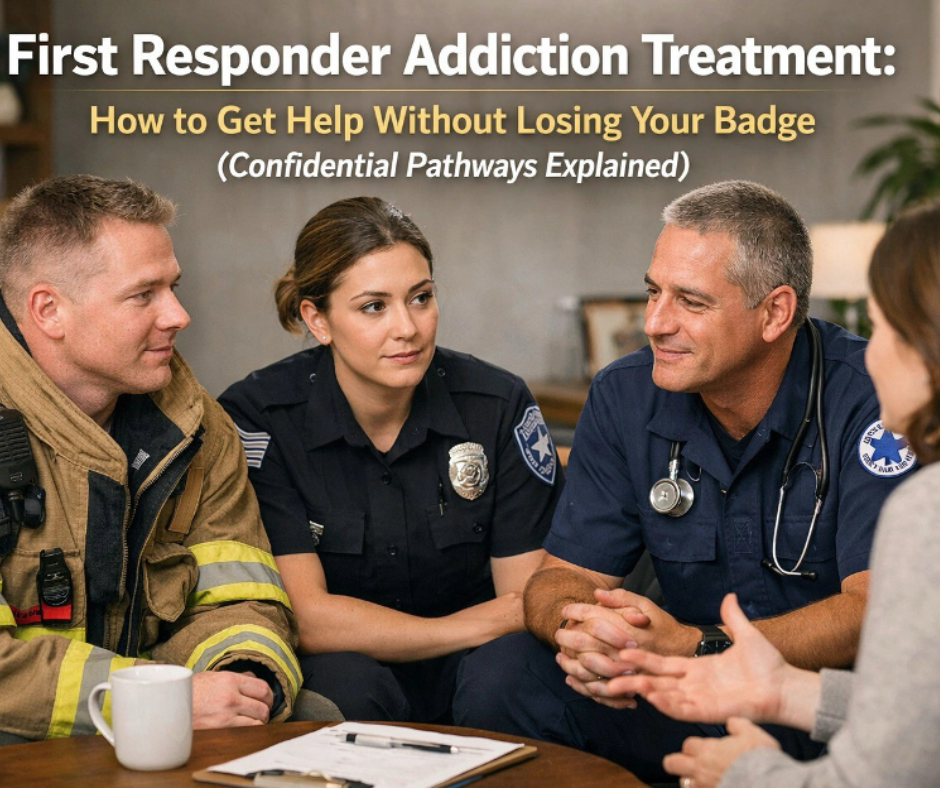
Livengrin’s First Responder Addiction Treatment (FRAT) program was built specifically for police officers, firefighters, paramedics, dispatchers, corrections officers, and emergency medical professionals. We recognize that your relationship with substances often started as a coping mechanism for im-possible circumstances: and that recovery requires addressing both the addiction and the underlying trauma.
Our trauma-informed approach integrates:
- Cognitive Behavioral Therapy (CBT) to identify and change thought patterns that fuel both trauma responses and substance use
- Dialectical Behavior Therapy (DBT) for emotion regulation and distress tolerance
- Cognitive Processing Therapy (CPT) to specifically target PTSD symptoms, survivor’s guilt, and the moral injury many first responders carry
- Evidence-based addiction treatment including Medication-Assisted Treatment (MAT) when clinically appropriate
This isn’t just addiction treatment with a first responder sticker on it. It’s clinical care redesigned around the realities of your profession.
The Power of Peer Support in First Responder Recovery
One of the most powerful components of specialized first responder treatment is the peer environment. You’re not explaining your job to civilians who can’t comprehend what you’ve experienced. You’re surrounded by others who’ve worn the uniform, worked the scene, and carried the weight.
In group sessions, first responders quickly recognize they’re not alone. The firefighter struggling with alcohol understands the paramedic dealing with prescription pills. The police officer battling intrusive thoughts connects with the dispatcher who can’t shut off the mental scanner. You’re not the broken one in a room of people who have it together. You’re part of a community working toward healing together.
Many first responders describe this peer connection as the turning point: the moment they realized recovery was possible because they saw it working for someone who truly understood their world.
Treatment Levels Designed Around Your Life and Career
We know you can’t disappear for months without consequences. Our program offers multiple levels of care, allowing you to access the intensity of support you need while maintaining as much stability as possible.
Medically Supervised Detox: If you’re physically dependent on substances, safe withdrawal management is the essential first step. Our medical team monitors you 24/7, managing symptoms and ensuring your comfort and safety.
Partial Hospitalization Program (PHP): Intensive day treatment (typically 6-8 hours daily, five days per week) provides structure and clinical support while allowing you to sleep at home. This level works well if you’re on approved leave but want to maintain some daily routine.
 Intensive Outpatient Program (IOP): With sessions typically scheduled 9+ hours per week (often in evening blocks), IOP offers significant clinical support while accommodating work schedules. Many first responders transition to this level as they prepare to return to duty.
Standard Outpatient Treatment: The most flexible option, with individual and group sessions scheduled around your shifts. Ideal for ongoing support and relapse prevention.
Your treatment plan isn’t one-size-fits-all. We meet you where you are: assessing your clinical needs, professional situation, and personal circumstances to design a pathway that works.
How to Take the First Step (Confidentially)
If you’re reading this, you’ve likely been weighing this decision for a while. Maybe you’ve tried to cut back on your own. Maybe you’ve had close calls. Maybe you’re just tired of living this way.
Here’s how to move forward without broadcasting it to your department:
Contact Livengrin directly. You can call our confidential helpline or submit a private inquiry through our website at livengrin.org. You control what information is shared and with whom.
Request a confidential assessment. Our clinical team will evaluate your needs in a private, judgment-free conversation. This isn’t an interrogation. It’s a collaborative discussion about what treatment approach makes sense for your situation.
Discuss leave options. If you need time away from work, we can provide documentation for FMLA or other approved leave without disclosing specific details about substance use. You have options be-yond “telling your captain everything.”
Explore insurance coverage. Most health insurance plans cover addiction treatment, and you can verify benefits confidentially. Our admissions team can help you understand what’s covered without involving your employer.
Consider bringing in family. If you’re ready, family therapy sessions can help repair relationships and build a home support system: but only when you’re comfortable with that step.
You Don’t Have to Choose Between Your Badge and Your Life
The culture of first responders teaches you to be strong, stoic, and self-sufficient. Those qualities make you excellent at your job. But they also make it nearly impossible to ask for help when you need it most.
Seeking treatment isn’t weakness. It’s the bravest decision you can make: not just for yourself, but for your family, your colleagues, and the community counting on you to show up whole.
You’ve spent your career running toward danger to help others. Now it’s time to extend that same courage to yourself. Livengrin’s First Responder Addiction Treatment program provides the confidential, peer-supported, trauma-informed care you need to reclaim your health without sacrificing your career.
Your badge doesn’t define you. But it also doesn’t have to cost you your life.
Ready to take the next step? Contact Livengrin Foundation confidentially at livengrin.org or call to speak with a specialist who understands your unique situation. Recovery is possible. Your career can be protected. And you don’t have to do this alone.
HR Directors: Your Quick-Start Guide to Placing Employees Into Addiction Treatment (Do This First)
 You got the call. Or maybe you noticed the pattern yourself: declining performance, missed shifts, be-havior changes. Now you’re sitting across from an employee who needs help, and you’re trying to navigate company policy, legal obligations, insurance logistics, and genuine human concern all at once.
This isn’t in the employee handbook. And frankly, most HR training doesn’t prepare you for this moment.
At Livengrin Foundation, we’ve partnered with Pennsylvania employers for over six decades, helping HR professionals navigate exactly this situation. Whether you’re dealing with a voluntary request for help or intervening after a workplace incident, here’s your quick-start guide to getting an employee into treatment while protecting both them and your organization.
Step 1: Understand What You’re Actually Dealing With
Before you do anything else, get clear on the situation you’re facing. This matters because it deter-mines your legal obligations, the employee’s protections, and the pathway forward.
Is this a voluntary request for help? If an employee proactively discloses a substance use issue and asks for support, you’re in the best possible scenario. The Americans with Disabilities Act (ADA) pro-tects employees who seek treatment for substance use disorders. Your role shifts to accommodation and support.
Is this a performance or conduct issue? If substance use hasn’t been disclosed but performance problems or policy violations have occurred, you’re addressing the behavior: not diagnosing addic-tion. Document the performance issues separately from any suspicions about underlying causes.
Has there been a workplace incident? Accidents, safety violations, or incidents involving impair-ment create different obligations. Many companies have mandatory testing policies triggered by spe-cific events. Know your company policy and follow it consistently.
What does your employee assistance program (EAP) cover? Most companies offer EAP benefits that include assessment, referral, and limited counseling sessions. This is often your first resource and can help determine appropriate next steps.
Step 2: Know Your Legal Responsibilities (And Protections)
HR directors walk a tightrope between supporting employees and protecting the company. Here’s what you need to know:
The ADA protects employees seeking treatment. Substance use disorder is recognized as a disabil-ity under the ADA. If an employee is actively participating in treatment or has completed a program, you cannot take adverse action based solely on their history of addiction. However, you can hold them accountable for job performance and conduct violations.
FMLA may apply. The Family and Medical Leave Act allows eligible employees to take up to 12 weeks of unpaid, job-protected leave for serious health conditions, including addiction treatment. If your company is covered (50+ employees) and the employee qualifies (worked 1,250+ hours in the past year), FMLA protections likely apply.
State laws vary. Pennsylvania has specific regulations around workplace drug testing, employee pro-tections, and workers’ compensation considerations. Consult with legal counsel familiar with Pennsyl-vania employment law to ensure compliance.
Confidentiality is critical. HIPAA protections mean treatment providers cannot share information about an employee’s participation in a program without written consent. Create systems that protect employee privacy while allowing necessary communication for leave management and return-to-work planning.
Step 3: Have the Conversation (Without Playing Therapist)
 If you need to initiate a conversation with an employee about seeking treatment, here’s how to ap-proach it professionally and compassionately:
Focus on observable facts. Stick to documented performance issues, attendance problems, or be-havior changes. “I’ve noticed you’ve missed four Monday shifts in the past six weeks” is appropriate. “You seem like you might be drinking too much” is not.
Express concern, not judgment. “I’m concerned about these changes and want to make sure you have the support you need” opens the door without cornering someone.
Offer resources, don’t diagnose. Your role isn’t to determine if someone has a substance use disor-der. Provide information about EAP services, treatment options, and company policies around leave and accommodation.
Be clear about consequences and support. “The performance issues need to be addressed, and I want to help you access resources that can support you. Here are the options available.”
Document the conversation. Keep factual records of what was discussed, resources offered, and any commitments made. This protects both the employee and the company.
Step 4: Connect Them With Appropriate Treatment Resources
Once an employee is ready to seek help, you need to know where to direct them. Not all treatment programs are created equal, and matching the employee’s needs with the right level of care matters.
Start with an assessment. Professional treatment facilities like Livengrin offer confidential assess-ments to determine appropriate level of care. This takes the guesswork out of your hands and en-sures clinical decisions are made by qualified professionals.
Understand levels of care:
- Detox: Medically supervised withdrawal management for individuals with physical Typically 3-7 days.
- Residential/Inpatient: 24/7 structured treatment Programs typically run 28-90 days.
- Partial Hospitalization (PHP): Day treatment (6-8 hours daily) with overnight stays at Of-fers intensive support while maintaining some daily structure.
- Intensive Outpatient (IOP): Typically 9+ hours per week, scheduled around work Al-lows employees to maintain employment while receiving treatment.
- Standard Outpatient: Individual and group therapy sessions scheduled Best for ongoing support and relapse prevention.
Consider the employee’s situation. Someone with significant family obligations, a supervisory role, or limited leave availability may need a different treatment approach than someone who can take ex-tended time off. Work with treatment providers to identify what’s clinically appropriate and practically feasible.
Verify insurance coverage. Most health plans cover addiction treatment, but navigating benefits can be complex. Reputable treatment facilities have admissions specialists who can verify coverage and explain out-of-pocket costs before admission.
Step 5: Manage the Leave and Return-to-Work Process
Once an employee enters treatment, your focus shifts to managing their absence and planning for successful reintegration.
Process leave requests properly. If FMLA applies, ensure paperwork is completed correctly. Work with the treatment facility to obtain necessary medical certification without requesting inappropriate clinical details.
Maintain confidentiality. When communicating with the employee’s team about their absence, pro-vide only necessary information. “Jane is on approved medical leave” is sufficient. Speculation about the nature of their leave violates privacy and creates liability.
Stay in appropriate contact. Check in periodically during treatment, but respect boundaries. A brief message: “Hope you’re doing well. We’re here when you’re ready to discuss return to work”: main-tains connection without being intrusive.
 Plan the return. Before the employee comes back, discuss any needed accommodations. Flexible scheduling for ongoing outpatient appointments? Modified duties while they rebuild stamina after residential treatment? Documenting reasonable accommodations protects both parties.
Consider return-to-work agreements. Some companies implement agreements outlining expecta-tions (ongoing treatment participation, random drug testing, performance benchmarks) as conditions of continued employment post-treatment. Consult legal counsel before implementing these to en-sure compliance with ADA requirements.
Step 6: Build Long-Term Support Systems
An employee completing treatment isn’t the end of your involvement: it’s the beginning of support-ing sustained recovery.
Ongoing accommodation may be needed. Attending 12-step meetings, therapy appointments, or medication management visits are part of recovery maintenance. Allowing flexible scheduling for these commitments is often considered reasonable accommodation under the ADA.
Monitor performance, not sobriety. Your role is to ensure job performance meets standards: not to police an employee’s recovery. If performance issues resurface, address them through normal perfor-mance management processes.
Reduce stigma in your workplace culture. Employees are more likely to seek help early when they don’t fear career consequences. Consider training managers to recognize signs of distress, promoting EAP resources, and creating a culture where mental health and addiction are treated like any other medical condition.
Know when relapse happens. Recovery isn’t always linear. If an employee relapses, the ADA may still provide protections if they re-engage with treatment. However, you can: and should: continue to hold them accountable for job performance and conduct expectations.
What Livengrin Offers HR Partners
We understand that HR directors need treatment partners who make this process as straightforward as possible. Here’s what working with Livengrin looks like:
Confidential assessments: We evaluate employees’ clinical needs and recommend appropriate level of care without requiring you to navigate clinical terminology.
Insurance verification: Our admissions team handles the insurance logistics, providing clear informa-tion about coverage and costs.
Flexible treatment levels: From medically supervised detox through outpatient care, we offer the full continuum so employees can access the right intensity of support.
FMLA documentation: We provide necessary medical certification for leave requests while maintain-ing appropriate confidentiality.
Return-to-work coordination: With employee consent, we work with HR teams to plan successful reintegration, including recommendations for reasonable accommodations.
Employer education: We offer consultation and training to help HR teams build effective policies and supportive workplace cultures.
You’re Not Expected to Be a Clinical Expert
Here’s what you need to remember: Your job isn’t to diagnose, treat, or fix an employee’s sub-stance use disorder. Your job is to connect them with people who can.
Be clear about performance expectations. Know your legal obligations. Offer resources without judg-ment. And partner with treatment providers who understand the workplace dynamics you’re navigat-ing.
When you get that call: the employee asking for help, the manager reporting concerns, the crisis that demands immediate action: you’ll know exactly what to do first.
Need to connect an employee with treatment or consult about a specific situation? Contact Livengrin Foundation at livengrin.org. Our admissions team works with HR professionals throughout Pennsylvania to make the treatment placement process clear, compliant, and compassionate.